Compatibility testing in progress
Compatibility
Bring a GGUF file. Every family runs on the GPU, and most on the CPU as well. Loculus Core reads what it needs from the model itself, so new releases of a supported family work as they arrive. Every model is validated against an exact reference before it is listed.
Model families
-
Llama
Llama 2, Llama 3.x, Mistral
-
Qwen
Qwen2, Qwen2-VL (text), Qwen3, Qwen3 MoE
-
Qwen3.8
27B and Flash-Next: hybrid recurrent + attention, with image input on both
-
DeepSeek V4.1
Latent attention, 748B MoE streamed from SSD, with image input
-
GLM
GLM-4 (GPU and CPU); GLM-5.3 (GPU), with image input on GLM-5.3 Flash
-
Nemotron 3.5 Lightning
Hybrid Mamba-2 MoE
-
gpt-oss
MXFP4 mixture of experts
-
Gemma
Gemma 2 and 3 (GPU and CPU); Gemma 4 dense, MoE, E2B and E4B (GPU), with image input on E4B, 12B and 26B-A4B
-
Phi
Phi-3, Phi-4
-
Granite
IBM Granite
-
SmolLM3
Long-context small model
-
OLMo 2
Fully open model family
-
LFM2
LFM2 and LFM2.5: gated short convolutions + attention
Image models
Text-to-image diffusion: the prompt is read by the model’s text encoder, a diffusion transformer refines noise into a picture over a few steps, and the autoencoder decodes it to pixels. The transformer and decoder run on the GPU, the text encoder on the CPU, so pictures need a Vulkan GPU.
-
Z-Image-Turbo
Tongyi-MAI
- Diffusion transformer
- GGUF (Q8_0)
- Text encoder
- Qwen3-4B, GGUF (Q8_0, BF16)
- Autoencoder
- FLUX.1’s, safetensors
Any width and height in steps of 16 pixels, from the command line or through the OpenAI Images API, served beside a chat model.
-
FLUX.3 [klein]
Black Forest Labs
- Diffusion transformer
- safetensors (bf16)
- Text encoder
- Qwen3-VL-4B-Instruct, GGUF (F16, Q8_0)
- Autoencoder
- FLUX.2’s, safetensors
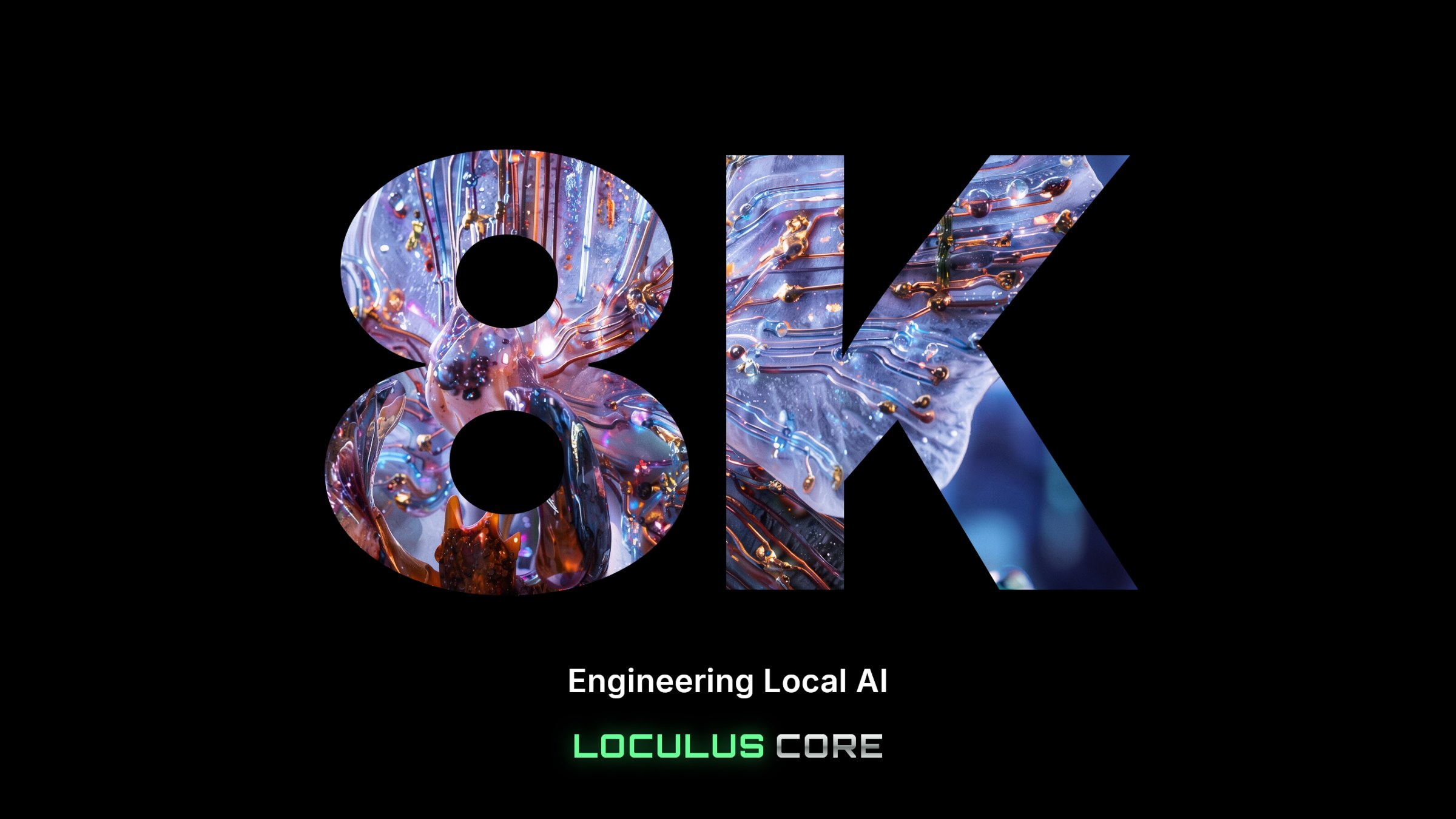
The distilled [klein] model, 16 steps by default. Any width and height in steps of 16 pixels, from the command line or through the OpenAI Images API: native 8K (7680 × 4320) on a 96 GB machine, native 4K (3840 × 2160) on a 16 GB graphics card. Verified on Linux and Windows.
Models aren’t included with Loculus Core: you download each one from its publisher and use it under its own licence, which may limit commercial use. FLUX.3 [klein], for example, is released under Black Forest Labs’ FLUX Kommunity License: non-commercial use, and for businesses under US$5 million a year in revenue, commercial use of the pictures it makes. For other uses, Black Forest Labs offers commercial licences.
Video models
Text-to-video and picture-to-video diffusion: the model’s text encoder reads the prompt, a diffusion transformer refines noise into the whole clip over a few steps, and the autoencoders decode it to frames, and with LTX-2.5 to its sound. Ask for a size and a length in seconds, and Loculus Core plans the rest. Video needs a Vulkan GPU.
-
LTX-2.5
Lightricks
- Diffusion transformer
- 22B distilled, GGUF (Q8_0)
- Text encoder
- LTX’s own Gemma 4 12B, from Lightricks’ release
- Autoencoders
- video and audio, safetensors
- Upscaler
- x2 latent upsampler, safetensors
Video and its synchronised sound in one pass, from a prompt or a picture: rain, footsteps, music, voices with moving lips. 24 frames a second, up to native 4K. From the command line, or through OpenAI’s videos API beside a chat model.
-
Wan 2.2 TI2V-5B
Wan team, Alibaba
- Diffusion transformer
- GGUF (Q8_0)
- Text encoder
- umT5-XXL’s encoder, GGUF (Q8_0)
- Autoencoder
- Wan 2.2’s, safetensors
Text to video, or from a picture. 24 frames a second, from 480p to 4K: above its trained 720p, Loculus Core makes the video at 720p and redraws it at full size with the model’s own weights.
-
Wan 2.2 I2V-A14B
Wan team, Alibaba
- Diffusion transformers
- two 14B experts, GGUF (Q8_0)
- Text encoder
- umT5-XXL’s encoder, GGUF (Q8_0)
- Autoencoder
- Wan 2.1’s, safetensors
Picture to video at 720p, 16 frames a second. Clips longer than five seconds carry on from their last frame, and on a 16 GB graphics card the experts stream from system memory.
-
Wan 2.2 T2V-A14B
Wan team, Alibaba
- Diffusion transformers
- two 14B experts, GGUF (Q8_0)
- Text encoder
- umT5-XXL’s encoder, GGUF (Q8_0)
- Autoencoder
- Wan 2.1’s, safetensors
Text to video at 720p, 16 frames a second.
LTX-2.5 is released by Lightricks under its LTX-2.x Community License: free for individuals and for companies under US$10 million a year in revenue; larger companies need a commercial licence from Lightricks. Wan 2.2 is released by the Wan team at Alibaba under Apache 2.0.
Quantization formats
- Q8_0
- Q4_0
- Q4_1
- Q5_0
- Q5_1
- Q2_0
- Q2_K
- Q3_K
- Q4_K
- Q5_K
- Q6_K
- F32
- F16
- BF16
- IQ1_S
- IQ1_M
- IQ2_XXS
- IQ2_XS
- IQ2_S
- IQ3_XXS
- IQ3_S
- IQ4_NL
- IQ4_XS
- MXFP4
Platform
- GPU
- Vulkan compute, with or without matrix cores. Broader GPU testing is under way.
- CPU
- x86-64, vector-accelerated. Runs without a GPU.
- Models
- GGUF files, single or split. Experts stream from the SSD when a model is larger than memory. Image models also take their autoencoder as safetensors.
- APIs
- Anthropic Messages, OpenAI Responses and OpenAI Chat Completions, streamed or not, with tool calls, structured outputs and image input (Qwen3.8, Gemma 4, GLM-5.3 Flash and DeepSeek V4.1 Flash). The OpenAI Images API for pictures, with a seed and a step count, and OpenAI’s videos API for video: a prompt, a picture, a size and a length in seconds.
- Operating systems
- Linux first, then Windows, Android, macOS and iOS.
- Your devices
- One purchase, linked to your account: sign in with Google or Apple and download Loculus Core on any device you use.
Model names and trademarks belong to their owners; FLUX is a trademark of Black Forest Labs Inc. Loculus Core is independent and isn’t affiliated with or endorsed by any model’s publisher.